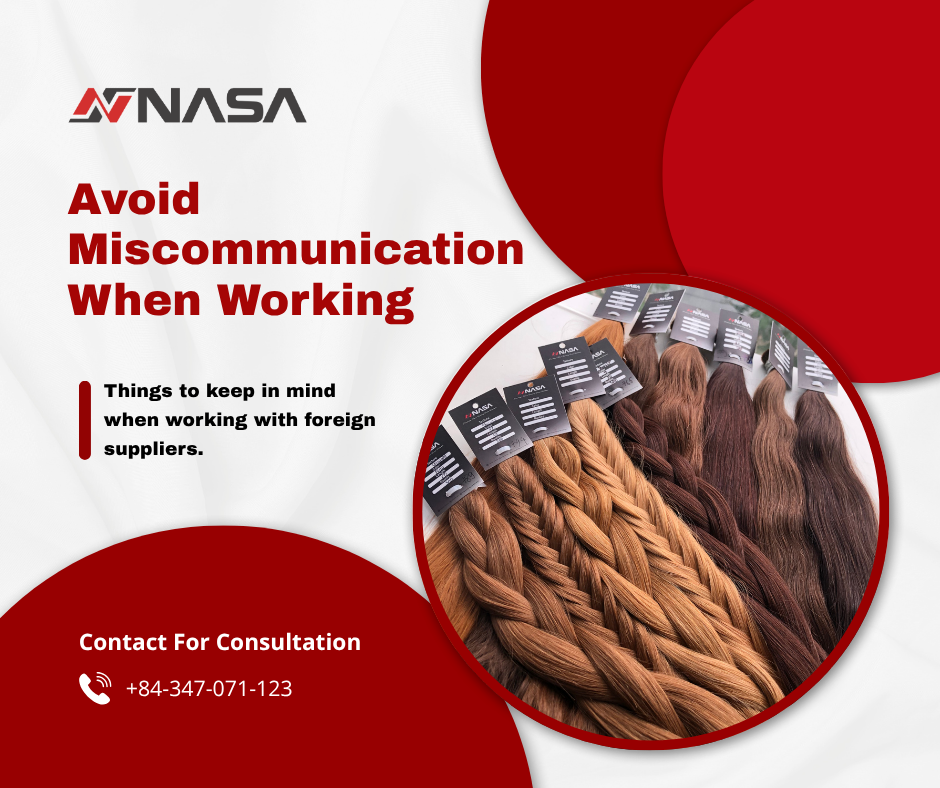
In international sourcing, most problems do not come from bad intentions—they come from unclear communication.
In the hair extensions industry, this risk is even higher because products are not standardized. Terms like “premium,” “double drawn,” or even “blonde” can have different meanings depending on the supplier’s internal system.
For buyers in Europe and the United States working with factories in countries like Vietnam or China, differences in language, technical interpretation, and production processes create additional complexity.
According to global trade and supply chain research, communication gaps are among the top causes of order disputes in cross-border manufacturing. In hair wholesale, this often results in:
Understanding this risk is the first step toward solving it.
One of the biggest challenges in hair supplier communication is the gap between intention and interpretation.
For example, a buyer may request “thick ends” or “high-quality blonde,” assuming the supplier understands exactly what that means. However, without measurable standards, the factory will interpret these requests based on its own internal definitions.
In manufacturing environments, this issue is known as specification ambiguity. According to quality management principles such as those outlined in ISO 9001, ambiguity in product requirements is a primary source of inconsistency.
In the hair industry, ambiguity leads to:
This is why professional buyers move away from descriptive language and toward technical clarity.
Verbal discussions, chat messages, or quick confirmations are not sufficient when dealing with wholesale hair orders.
Professional sourcing requires documented specifications.
Clear documentation should include:
When these details are written and confirmed by both sides, the risk of misunderstanding decreases significantly.
This approach reflects global procurement standards, where written agreements are essential for ensuring consistent production outcomes.
Hair is a visual product. Describing it with words alone is not enough.
One of the most effective international hair business tips is to always combine written specifications with visual references.
This includes:
Visual alignment ensures that both buyer and supplier are discussing the same standard.
In professional manufacturing, this is similar to using “golden samples”—reference products that define the expected outcome for future production.
A common issue in the hair industry is that the sample looks perfect, but the bulk order does not match.
This problem often comes from miscommunication about production scale.
Buyers should always confirm:
Without this clarification, factories may deliver the sample with higher control and the bulk with different conditions.
Understanding this difference is critical for maintaining consistency in wholesale orders.
Working with overseas factories also introduces time zone challenges.
Delays in response can slow down decision-making and increase the risk of mistakes, especially when production timelines are tight.
Professional buyers manage this by:
Structured communication reduces confusion and ensures that important details are not lost.
Cultural differences can also influence how information is communicated.
In some manufacturing environments, suppliers may avoid directly saying “no” or highlighting limitations. Instead, they may agree in principle but adjust during production.
For buyers, this means it is important to:
In global supply chain management, open and direct communication is strongly linked to higher supplier performance and lower defect rates.
Over time, the most successful distributors develop standardized communication systems with their suppliers.
This may include:
Standardization reduces the need to repeat instructions and minimizes the chance of errors.
In manufacturing, this is known as process control, and it is a key factor in scaling operations without losing consistency.
Finally, strong communication is built on transparency from both sides.
A reliable supplier should:
At the same time, buyers should communicate:
When both sides share accurate information, the partnership becomes more efficient and predictable.
Miscommunication is not a minor inconvenience—it is one of the biggest hidden risks in the hair wholesale business.
By focusing on structured hair supplier communication, using clear specifications, visual references, and standardized processes, buyers can significantly reduce errors and improve consistency.
In international sourcing, clarity is not optional. It is the foundation of a successful and scalable hair business.
To avoid miscommunication when working with overseas suppliers, buyers must rely on clear written specifications, visual references, and structured communication systems. These international hair business tips help reduce risk, improve consistency, and build stronger long-term partnerships.
+84347071123

 French
 Russian